CSEL SCIENCE
Promote Partner and Small Group Work.
CSEL Science promotes student discussion through partner and small group learning. To the extent possible, ELs at entering and emerging levels of English proficiency are partnered with bilingual students. Students who are good decoders and understand the text are paired with students who need support with decoding and understanding the text. In heterogeneous classrooms, teachers work with newcomers in a small group while other students work with partners or in heterogeneous small groups on the same tasks.
Note: Also see Interactive Reading example that highlights how students work individually or with a partner to read grade-level science text, answer comprehension questions, and debrief as a class.
Writing Frame
Description of key features highlighted:
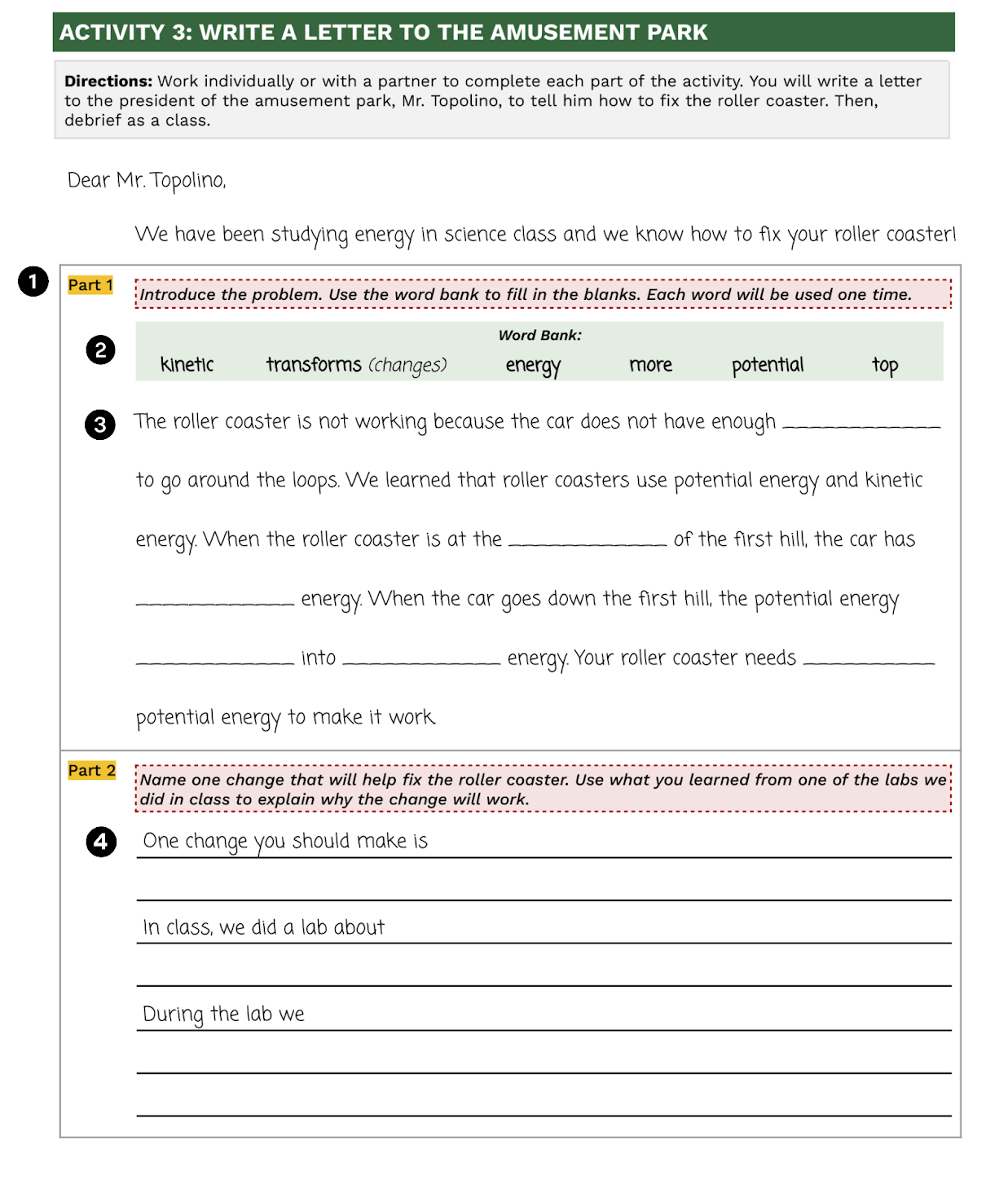
1
The writing task is chunked and clearly labeled to reduce cognitive load and guide students in responding fully to the intent of the letter –how to fix the roller coaster. Directions are broken into smaller sections and appear above each part of the writing task, helping students focus on part of their response at a time.
2
A word bank is provided to encourage the use of discipline-specific vocabulary and to support students in accurately communicating scientific ideas.
3
For the first part of the writing task, students are given a paragraph frame with blanks to fill in. The word bank includes the terms they will need to complete the paragraph. This frame models scientific thinking and communication, showing students how to structure and organize a response.
4
For the second part of the writing task, sentence starters are provided to support students’ organization and elaboration. In this example, students name a change and provide specific evidence from a classroom lab to support their proposed change, helping them develop a complete, well-supported explanation.
The image below shows part of a writing frame from Session 3.7:
Solving the Roller Coaster Problem that supports students in writing an extended response. In this activity, students write a letter to the president of Amusement Park, explaining how to fix the roller coaster. Numbered circles highlight key features and are described below the image.
Lab Work
Description of key features:
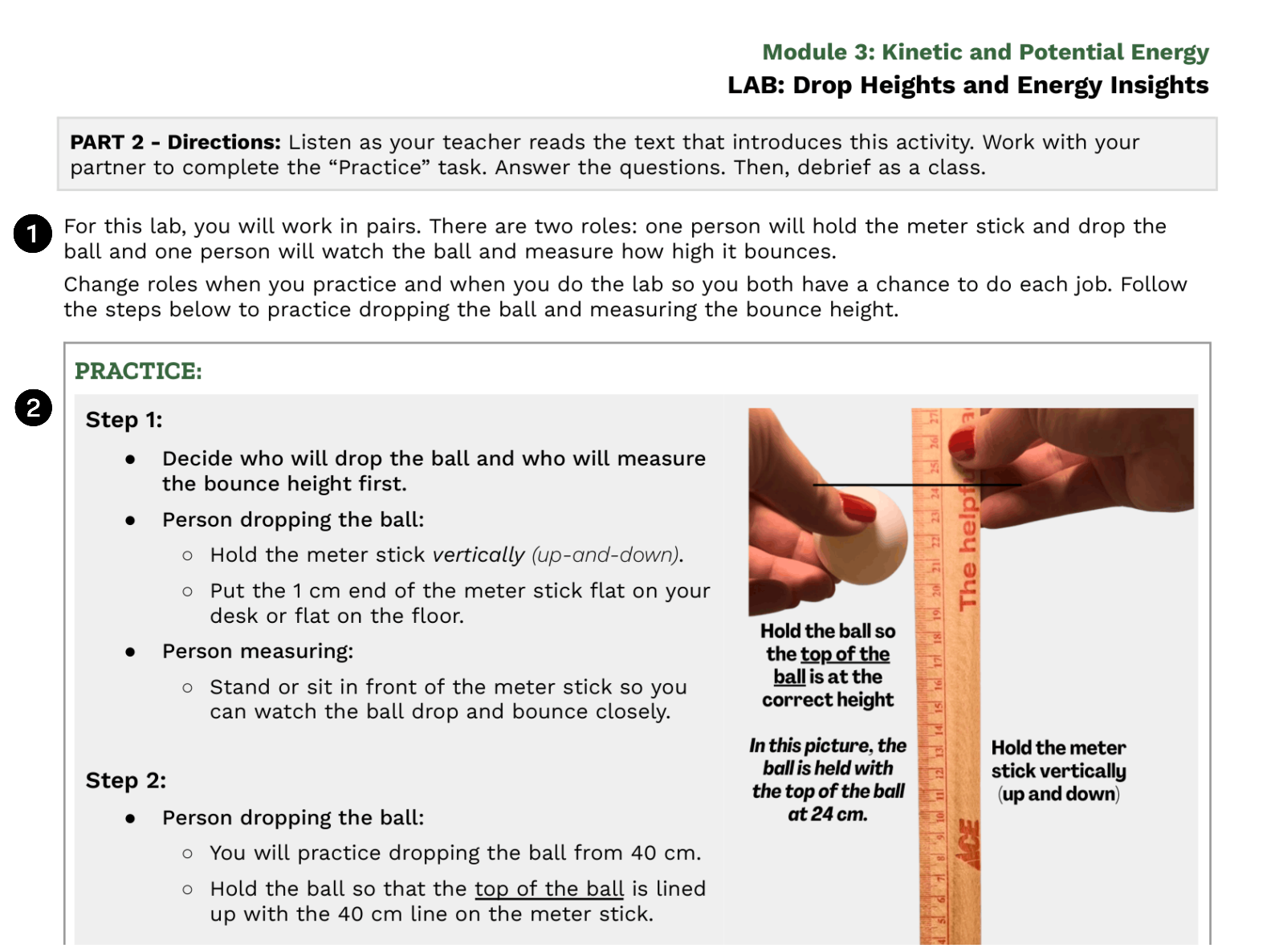
1
Students work with a partner and take on specific roles during lab activities. In this example, one student drops the ball while the other student measures the bounce height. Students switch roles so each partner has a chance to practice both parts of the procedure.
2
Students practice lab procedures before collecting data in the full lab activity. Step-by-step directions and labeled photos help students understand what to do, how to use materials, and how to work with their partner.
The image below shows part of a lab activity from Session 5.4:
Drop Heights and Energy Insights. In this activity, students work with a partner to investigate how drop height affects bounce height and how potential energy changes to kinetic energy when a ball is dropped. Numbered circles in the image highlight key features that are explained below.