
CSEL SCIENCE
High School Biology
Introduction to High Biology Module: Patterns of Inheritance and Applications
CSEL Science is aligned with the principles of phenomenon-based and three-dimensional learning as outlined in the
Framework for K–12 Science Education
(National Research Council, 2012) and the
Next Generation Science Standards (NGSS Lead States, 2013). CSEL science is also aligned with Inquiry-based learning.
CSEL Science: Phenomenon-based Learning
At the high school level, Module 7: Patterns of Inheritance and Applications helps students extend their understanding of inheritance beyond complete dominance. Across the module, students examine sex-linked traits, incomplete dominance, codominance, and inheritance patterns shown in family pedigrees. Students use Punnett squares to predict genotype and phenotype probabilities, interpret and build pedigree charts to track traits across generations, and apply these tools to a real-world case about sickle cell inheritance.
NGSS Three-Dimensional Learning
NGSS three-dimensional learning integrates three dimensions: science and engineering practices, disciplinary core ideas, and crosscutting concepts.
Science and Engineering Practices
Students develop and use models throughout the module. In Session 7.1:
Other Patterns of Inheritance, students use Punnett squares to model sex-linked traits, incomplete dominance, and codominance. They calculate genotype and phenotype probabilities and compare inheritance patterns. In Session 7.2:
Tracking Traits Using Pedigrees, students interpret pedigree symbols, identify affected individuals, and build pedigree charts to track traits through generations. In Session 7.3:
Sickle Cell Inheritance Lab, students apply Punnett squares and pedigrees to Sonia’s Story, using family information to explain how Sonia inherited sickle cell trait and to predict possible inheritance outcomes.
Across the module, students analyze genotype and phenotype tables, interpret pedigree charts, identify patterns, and use probability to make predictions. Students construct explanations orally and in writing as they connect allele combinations, observable traits, and evidence from genetic models. In the optional sickle cell extension, students also analyze the relationship between sickle cell trait and malaria resistance.
Disciplinary Core Ideas
The module centers on core ideas from HS-LS3: Heredity, Inheritance, and Variation of Traits. Students learn that genes are located on chromosomes and that different versions of genes, or alleles, can combine in different ways to influence traits. Students extend their understanding beyond complete dominance by studying sex-linked traits, incomplete dominance, codominance, and, optionally, multiple alleles.
Students use these inheritance patterns to explain how genotypes are related to phenotypes and how traits can be passed from parents to offspring. In the sickle cell inheritance case study, students connect allele combinations to red blood cell phenotypes, including normal red blood cells, sickle cell trait, and sickle cell anemia. The case gives students a real-world context for applying inheritance concepts to human health and family history.
Cross-cutting Concepts
Crosscutting concepts are woven throughout the module. Students identify patterns as they compare inheritance types and interpret how traits appear across generations in pedigrees. They use cause and effect reasoning to connect genotypes to observable phenotypes, including red blood cell phenotypes in the sickle cell case. Through Punnett squares and inheritance probabilities, students apply scale, proportion, and quantity to predict genotype and phenotype ratios. In the sickle cell extension, students consider how inheritance patterns can influence trait distribution in populations.
Students use these inheritance patterns to explain how genotypes are related to phenotypes and how traits can be passed from parents to offspring. In the sickle cell inheritance case study, students connect allele combinations to red blood cell phenotypes, including normal red blood cells, sickle cell trait, and sickle cell anemia. The case gives students a real-world context for applying inheritance concepts to human health and family history.
Inquiry-Based Learning
The module culminates with Sonia’s Story, a sickle cell inheritance case study. Students examine how red blood cell phenotypes connect to genotypes, use a family pedigree to trace how Sonia inherited sickle cell trait, and use Punnett squares to predict possible inheritance outcomes in the next generation. An optional extension connects sickle cell trait to malaria resistance, helping students consider how genetic variation can affect trait distribution in populations. Across the module, students use models, analyze patterns, apply probability, and construct evidence-based explanations about how allele combinations affect traits.
Alignment with NGSS Standards and Three-dimensional Learning
Below is documentation of how CSEL Science Module 7: Patterns of Inheritance and Applications is aligned with NGSS.
- HS-LS3-1: Students use Punnett squares and pedigrees to model how alleles are passed from parents to offspring and connected to observable traits.
- HS-LS3-2: Students analyze how new allele combinations can produce variation in genotypes and phenotypes, including through sex-linked traits, incomplete dominance, codominance, and sickle cell inheritance.
- HS-LS3-3: Students use probability to predict genotype and phenotype outcomes and interpret how traits appear across generations. In the extension, students also consider trait distribution in populations.
Module 7: Patterns of Inheritance and Applications
| Module 7 Sessions | Driving Question(s) | Science & Engineering Practices | Disciplinary Core Ideas | Crosscutting Concepts |
|---|---|---|---|---|
| Session 7.1: Other Patterns of Inheritance | How do incomplete dominance, codominance, and sex-linked traits differ from Mendel’s patterns? | Develop and use models; Analyze and interpret data; Use mathematics and computational thinking; Construct explanations | LS3.A, LS3.B | Patterns; Cause and effect; Scale, proportion, and quantity |
| Session 7.2: Tracking Traits Using Pedigrees | How can we track traits through generations? | Develop and use models; Analyze and interpret data; Construct explanations | LS3.A, LS3.B | Patterns; Cause and effect |
| Session 7.3: Sickle Cell Inheritance Lab | How can genetic models, such as Punnett squares and pedigrees, help explain sickle cell inheritance? | Develop and use models; Analyze and interpret data; Use mathematics and computational thinking; Construct explanations | LS3.A, LS3.B | Patterns; Cause and effect; Scale, proportion, and quantity |
| Optional Mini-Lesson: Multiple Alleles | How can a single gene have more than two alleles? | Develop and use models; Use mathematics and computational thinking; Construct explanations | LS3.A, LS3.B | Patterns; Cause and effect; Scale, proportion, and quantity |
In CSEL Science, the word “session” refers to a structured period of time devoted to a specific biology subtopic. Across three sessions, students engage in integrated use of Science and Engineering Practices (SEPs), Disciplinary Core Ideas (DCIs), and Crosscutting Concepts (CCCs). In Module 7, students extend their understanding of inheritance beyond complete dominance by comparing inheritance patterns, using pedigrees to track traits through families, and applying these tools to Sonia’s Story, a sickle cell inheritance case study. See table for session-by-session NGSS alignment.
Example Activities with Descriptions from Module 7
For example, Session 7.3: Sickle Cell Inheritance Lab aligns with NGSS Performance Expectation HS-LS3-3, which focuses on using probability to explain patterns of inherited traits. Instruction centers on a real biological phenomenon: the physical symptoms and differences in red blood cell shape associated with sickle cell anemia.
from Session 7.3: Sickle Cell Inheritance Lab
Activity 1: Set the Context

The session frontloads observable health effects rather than abstract genetic rules. Students build and use models, such as Punnett squares and pedigree charts, analyze data to identify inheritance patterns, and use probability to explain how sickle cell anemia appears in families. Crosscutting ideas, including patterns, cause and effect, structure–function, and scale, help students connect their reasoning across activities.
from Session 7.3: Sickle Cell Inheritance Lab
Activity 2: Learn about the Genetics of Sickle Cell Anemia

The phenomenon is revisited across the session as students move from explaining symptoms to predicting offspring traits, supporting sustained sensemaking rather than isolated or procedural work. An optional extension activity on malaria and heterozygote advantage is available for students who complete the core activities early. Teachers in states can implement this extension activity with an additional standard on how genetic and environmental factors influence traits.
from Session 7.3: Sickle Cell Inheritance Lab
Activity 3: Complete a Punnett Square for Sickle Cell Anemia
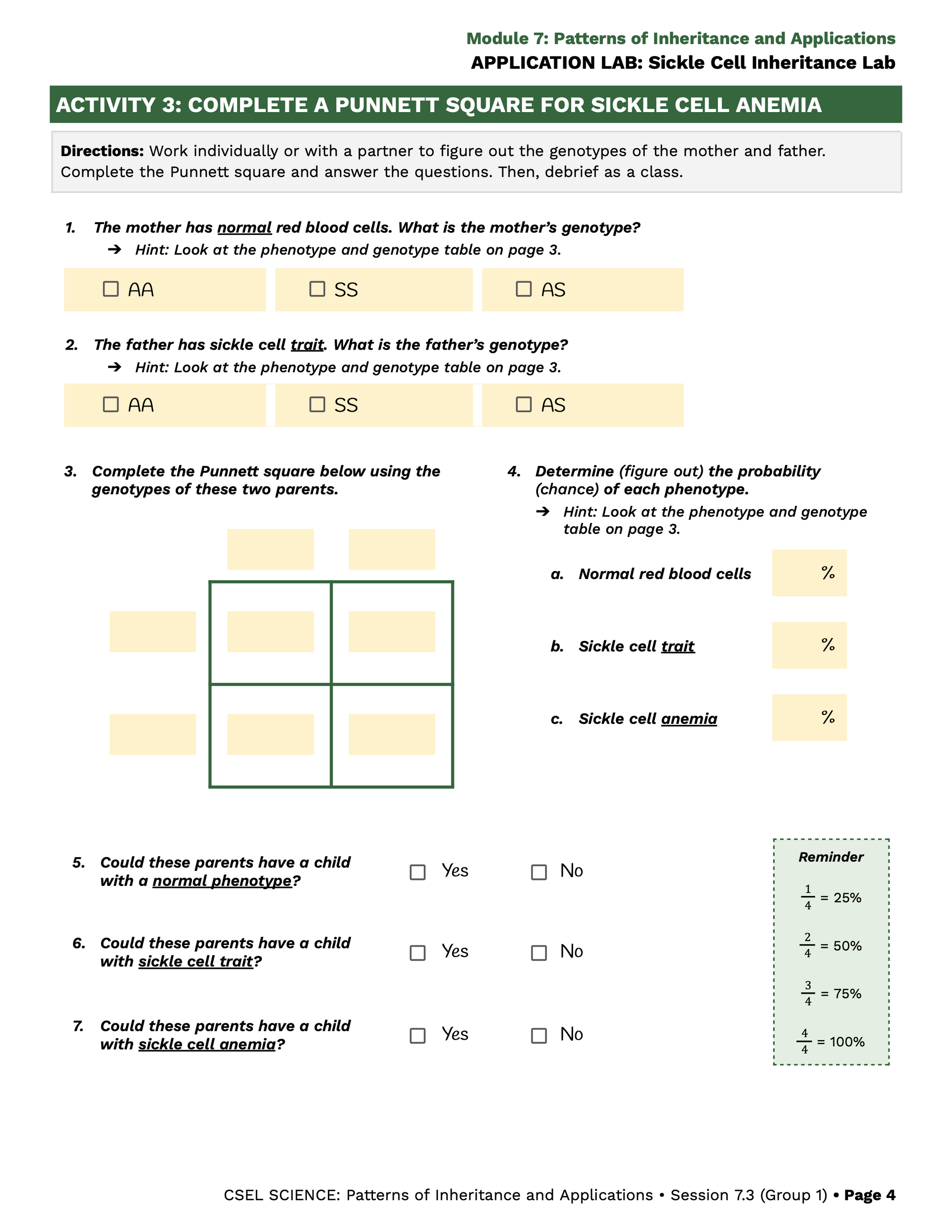
Session 7.3: Sickle Cell Inheritance Lab also illustrates both project-based and model-based learning through an investigation of sickle cell inheritance.
Students are tasked with investigating how a girl inherited the sickle cell gene and whether her future children are at risk of sickle cell anemia. Students analyze a real-world case, construct Punnett squares, and develop pedigree models to explain how a genetic trait is transmitted across generations.
from Session 7.3: Sickle Cell Inheritance Lab
Activity 4: Sickle Cell Case Study - Sonia's Story
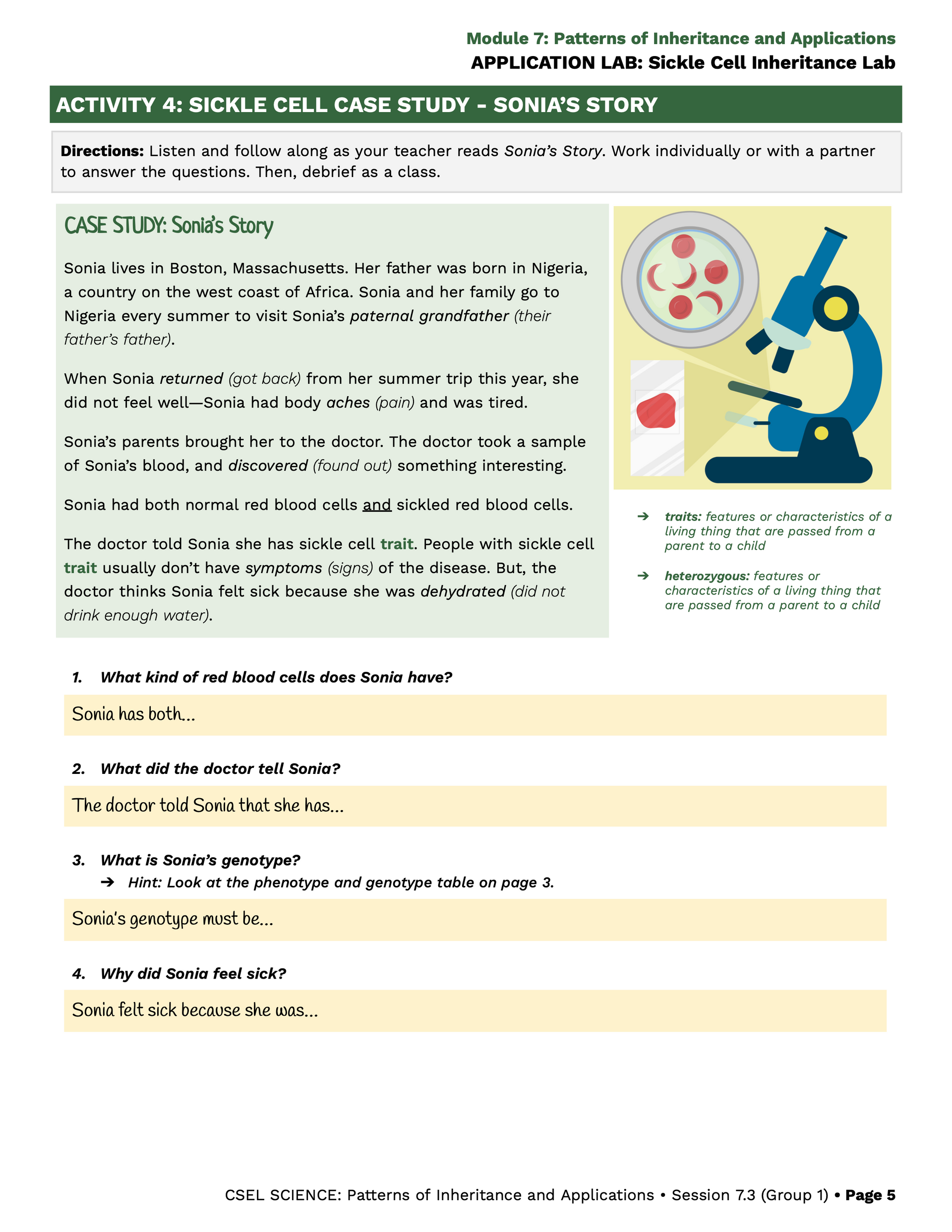
This sustained inquiry reflects core features of project-based learning, including collaborative analysis of evidence and application of genetics concepts to an authentic scenario. It also exemplifies model-based learning, as students generate and revise representational models to explain inheritance patterns and predict outcomes.
from Session 7.3: Sickle Cell Inheritance Lab
Activity 5: Investigate How Sonia Inherited Sickle Cell Trait
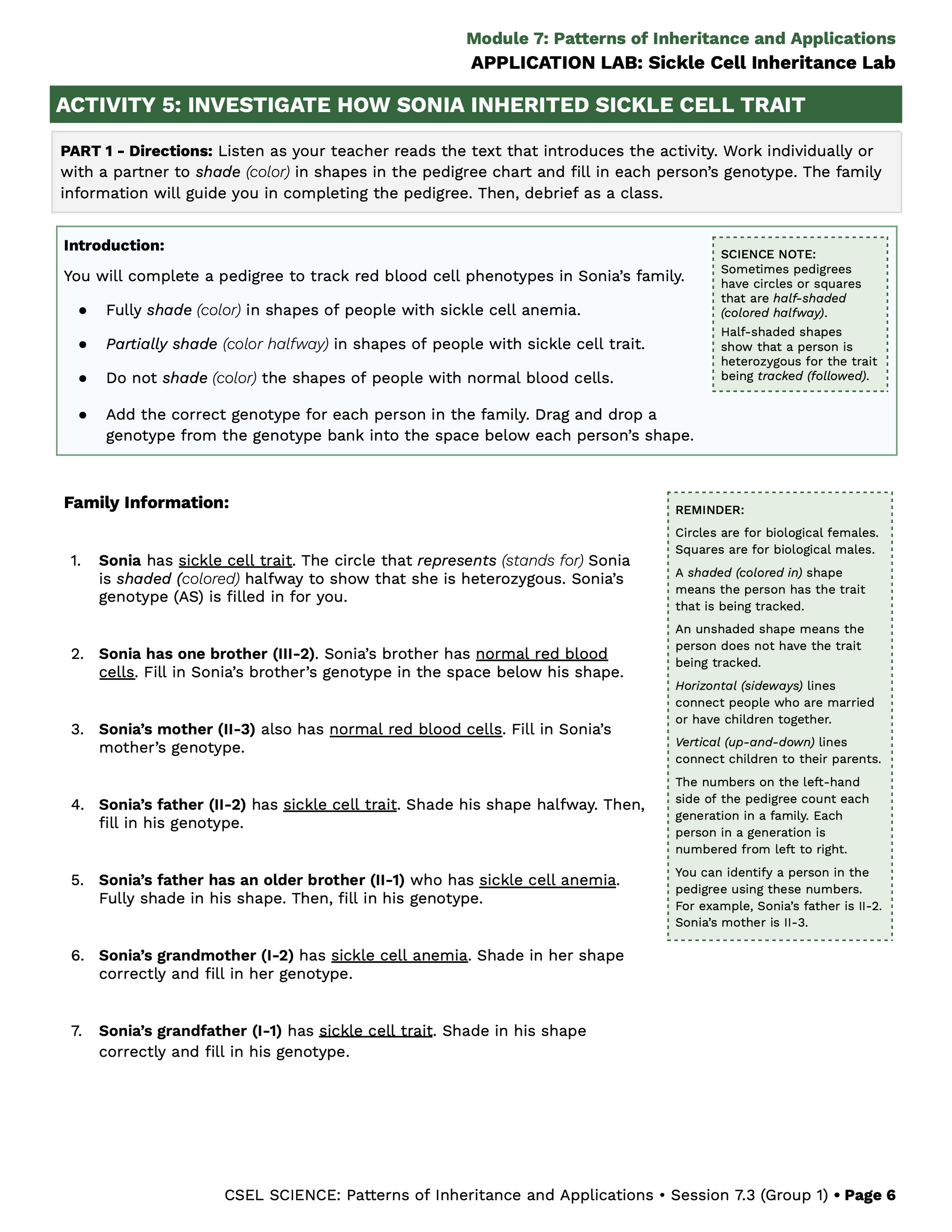
Together, these activities position students as sensemakers using models to explain a meaningful biological phenomenon.
from Session 7.3: Sickle Cell Inheritance Lab
Activity 6: Predict the Phenotypes & Genotypes of Sonia's Children
