CSEL SCIENCE
Engage in Interactive Reading.
CSEL Science uses interactive reading to integrate oral and written language into science teaching. There are bilingual versions of some reading passages and monolingual English versions of all the reading passages.
During interactive reading, CSEL Science offers multiple concise, grade-level passages that are carefully sequenced and scaffolded. Rather than reading silently and independently, for the most part, students work together to discuss and answer explicit and inferential questions, either orally or in writing, to support reflective (rather than receptive) reading. With teacher support, the class then discusses and reviews the answers together (see below).
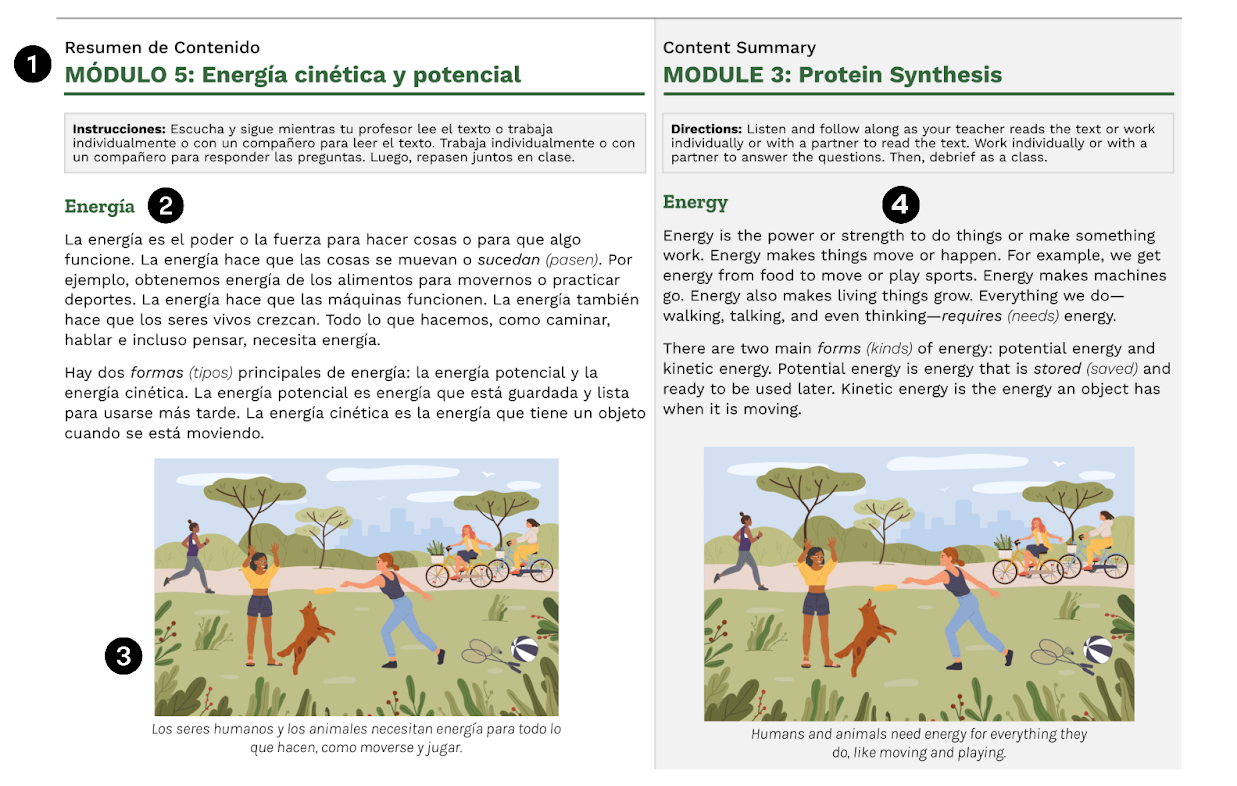
Side-by-Side Bilingual Content Summary
Description of key features highlighted:
1
In this bilingual version of reading passages, all content on the left side of the page, including the page title, directions, captions, and footers, is provided in the students’ home language. This supports comprehension and enables students to navigate the document independently without relying on English-only cues. There are also monolingual English versions of all reading passages with the same formatting.
2
The text is divided into smaller sections, making it easier for students to read and understand. Text features such as headers, subheaders, spacing, and bulleted lists help students identify key ideas, understand how information is organized, and navigate the content.
3
Captions and labels connected to images are provided in the home language. This helps students interpret visuals accurately and make clear connections between the illustrations and the accompanying text.
4
The same content is presented in English on the opposite side of the page. The mirrored structure enables students to move between their home language and English, supporting English language development while ensuring access to grade-level content in both languages.
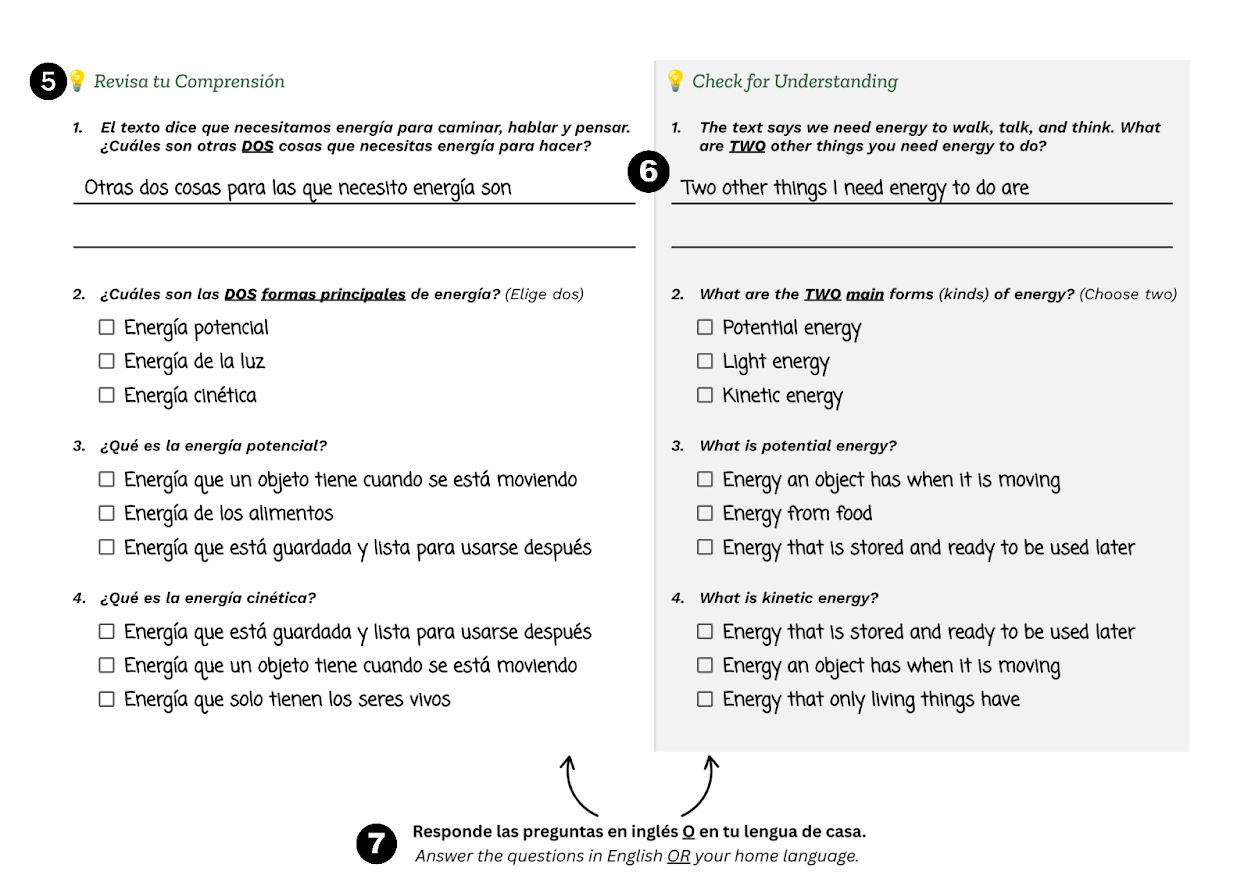
5
Comprehension questions are included to help students understand both the text and visuals. “Check for Understanding” questions include multiple-choice and open-response formats with sentence starters.
6
All comprehension questions and multiple-choice questions are translated into the home language. For open-response questions, sentence starters (also translated) support students in responding to the question.
7
Bilingual notes and instructions are included to help students navigate and use the document. These supports promote student independence, allowing teachers to focus on students' understanding rather than on navigating packets.
The images below and on the following page show the first two pages of the Spanish-English content summary for Module 5: Kinetic and Potential Energy. In this activity, students listen to and or read the text, and work individually or with a partner to answer questions, and then debrief as a class. Numbered circles in the images highlight key features.
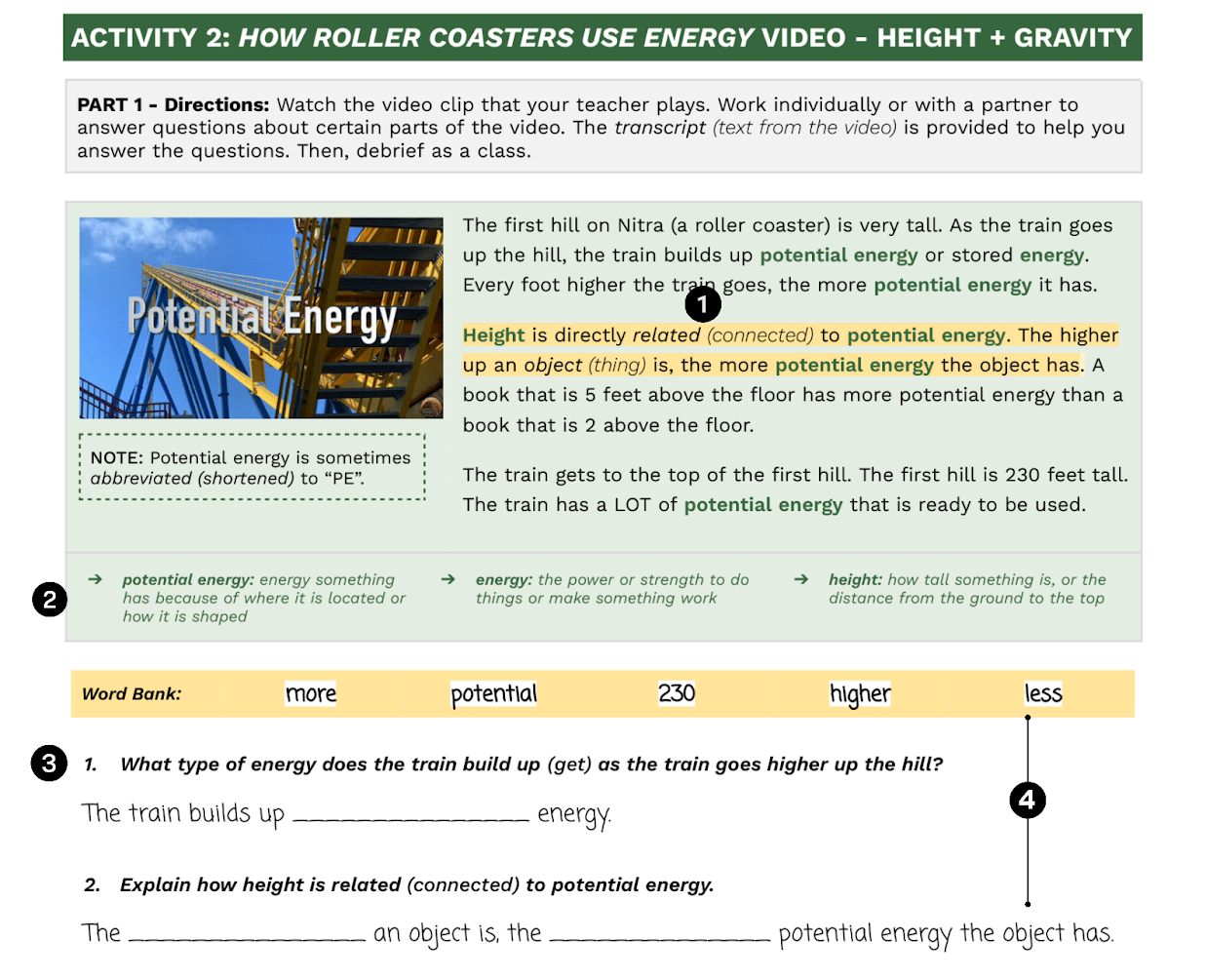
Video with Transcript and Associated Questions
Description of key features highlighted:
1
General academic words and phrases that are often less familiar to multilingual learners are defined directly in the text. These brief definitions support comprehension without interrupting the reading flow or requiring students to consult a separate glossary.
2
Key vocabulary words are defined close to where they appear in the text, typically in the margins or at the bottom of the page.
3
Embedded questions prompt students to process what they read or hear. Students work individually or in pairs to answer questions. The class then discusses and reviews the answers together.
4
Questions are scaffolded to support student responses. Depending on the task, supports may include sentence frames, sentence starters, and/or word banks. There is a version of these activities for English-proficient students who don’t need as much support, which does not include word banks, sentence starters, or sentence frames to help answer questions.
The image below shows an activity from Session 5.2: Feel the Energy - The Science of Roller Coasters. Students watch and listen to a video clip accompanied by a transcript, then answer the associated questions individually or with a partner. Numbered circles highlight key features that support students and are explained below.