CSEL SCIENCE
Support Discipline-specific and General Academic Vocabulary Development.
CSEL Science focuses on developing academic vocabulary because both discipline-specific and general academic words and phrases appear frequently in science texts and are critical for understanding secondary-level content (Lee et al., 2013; Fang & Schleppegrell, 2011). In CSEL Science, key discipline-specific vocabulary is previewed with picture cards and defined in the margins. General academic words and phrases commonly known to English-proficient students but not to ELs are defined in the text. A glossary accompanies each module; glossary words are bolded in the text so students know they can look them up.
Each module includes systematic support for clarifying academic words and phrases. Vocabulary is introduced in context through science scenes, hands-on exploration, scaffolded text, and labelled visuals rather than in isolation. In CSEL science, key discipline-specific vocabulary words that all students need to learn are previewed with picture cards (below). General academic words and phrases commonly known to English-proficient students but not to ELs are defined in the text in parentheses. Definitions for discipline-specific vocabulary words also generally appear in the margin on the right side or bottom of the same page where the words appear in text. As previously noted, students also have access to module glossaries. Definitions are reinforced through exit tickets, quizzes, games, and questions associated with the text.
Picture Cards
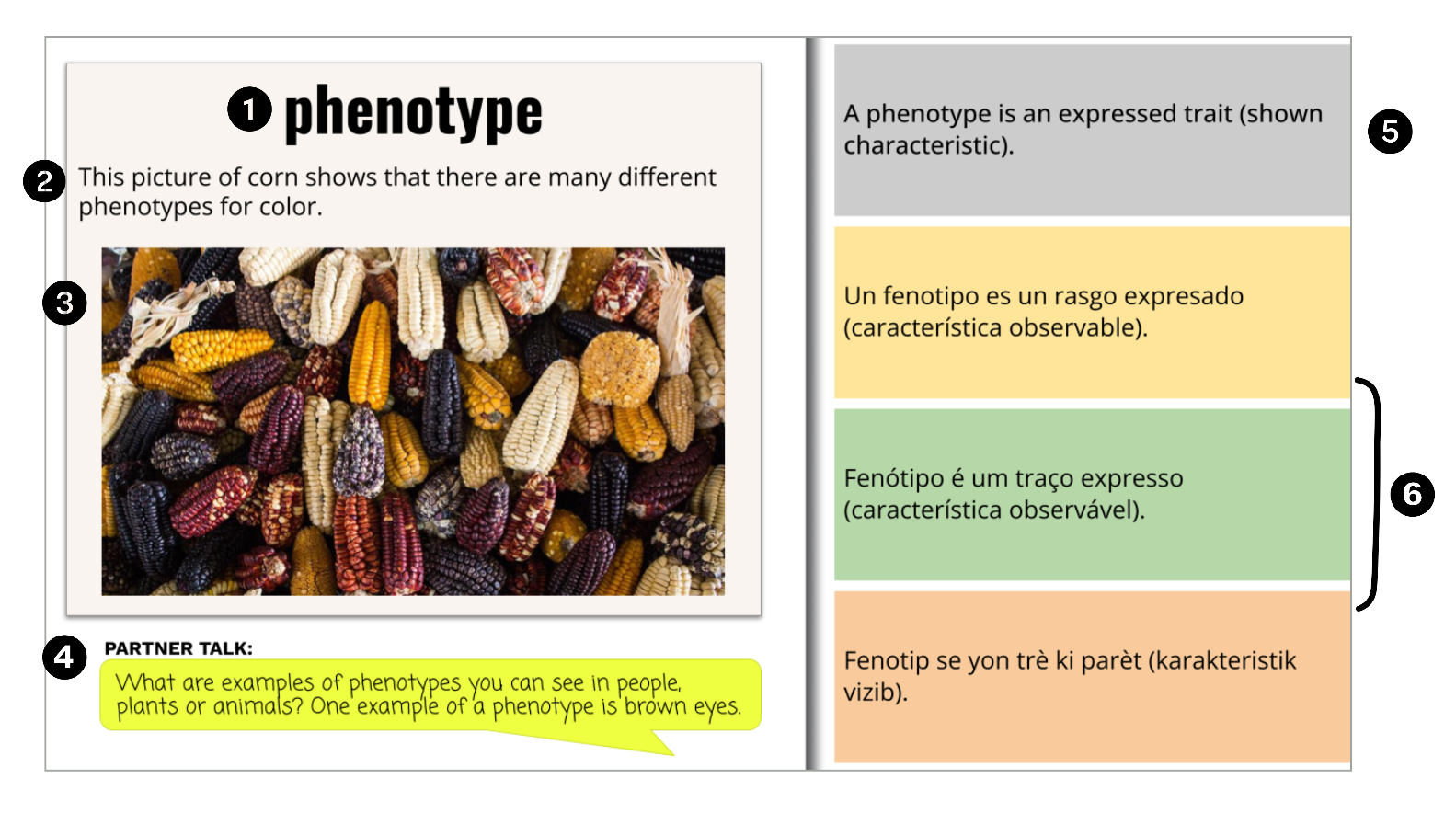
Description of key features highlighted:
1
The card shows the vocabulary word students will learn and use during the lesson.
2
A short sentence uses the target word and links it to the visual. This models how students can use the word accurately in speaking and writing.
3
A visual connects to the target word, giving students a concrete reference point for meaning.
4
A short partner talk question prompts students to use the target word to answer the question by drawing on background knowledge or connecting the concept to familiar examples.
5
A brief, student-friendly English definition provides a clear “first meaning” that students can return to during reading, discussion, and writing.
6
The card includes space for home-language definitions that teachers can add to match the languages and needs of a particular classroom.
The image below is an example of a picture card that the teacher uses to preview a target vocabulary word before students read or begin an activity. Key features are highlighted in the image below using circled letters; those features are explained on the left.