
CSEL SCIENCE
Middle School Integrated Science
Promoting Inquiry-based Learning
(middle school)
The Kinetic and Potential Energy module also illustrates CSEL Science’s inquiry-based learning approach. Students encounter a problem: a roller coaster cannot complete its loops. This problem gives students a reason to investigate how energy works in a system.
Across the module, students explore focused questions such as how height, mass, speed, and elasticity affect energy and motion. They conduct hands-on investigations with rubber bands, dropped balls, and collisions; record and compare data; identify patterns; and use evidence to support claims. In the culminating session, students use a digital roller coaster simulation to test changes to the system and explain how those changes affect the coaster’s motion. This sequence supports sustained sensemaking: students build understanding over time, revise their ideas as they gather evidence, and use scientific models and data to explain a meaningful real-world problem.
Phenomenon-Based Learning
As an example, the middle grades module Kinetic and Potential Energy is organized around an anchoring phenomenon: a roller coaster that cannot complete its loops because it lacks sufficient energy. Students return to this problem across the module as they investigate how energy is stored, transferred, and transformed in different systems. Students stretch rubber bands by different amounts to test how elastic potential energy affects motion, drop balls from different heights to investigate gravitational potential energy, and roll cars of different masses down ramps to explore how mass affects energy transfer during collisions. Across investigations, students record measurements, compare trials, graph and analyze data, identify patterns, and use evidence to support claims. Additionally, students develop and use models, including diagrams, energy representations, and a digital roller coaster simulation, to explain how kinetic and potential energy change within a system. By the end of the module, students apply evidence from their hands-on investigations and models to explain how the roller coaster can be redesigned to work.
Inquiry-based Learning
The Kinetic and Potential Energy module also illustrates CSEL Science’s inquiry-based learning approach. Students encounter a problem: a roller coaster cannot complete its loops. This problem gives students a reason to investigate how energy works in a system. Across the module, students explore focused questions such as how height, mass, speed, and elasticity affect energy and motion. They conduct hands-on investigations with rubber bands, dropped balls, and collisions; record and compare data; identify patterns; and use evidence to support claims. In the culminating session, students use a digital roller coaster simulation to test changes to the system and explain how those changes affect the coaster’s motion. This sequence supports sustained sensemaking: students build understanding over time, revise their ideas as they gather evidence, and use scientific models and data to explain a meaningful real-world problem.
Example Activities with Descriptions from Module 3
Session 3.1: Roller Coaster Rescue
Students begin by defining a real-world problem: a roller coaster that cannot complete its loops due to insufficient energy. In Session 3.1: Roller Coaster Rescue, students act out and discuss a science scenario in which the roller coaster is closed for repairs, prompting them to ask questions about energy, motion, and systems. Students plan and conduct investigations over multiple sessions.

Session 3.4: Elastic Energy in Action
In Session 3.4: Elastic Energy in Action, students stretch rubber bands by different amounts and measure how far a cup moves, directly testing how elastic potential energy affects kinetic energy and energy transfer.

Session 3.5: Drop Heights and Energy Insights
In Session 3.5: Drop Heights and Energy Insights, students drop ping-pong balls from increasing heights and measure the bounce height to investigate how gravitational potential energy changes with elevation.

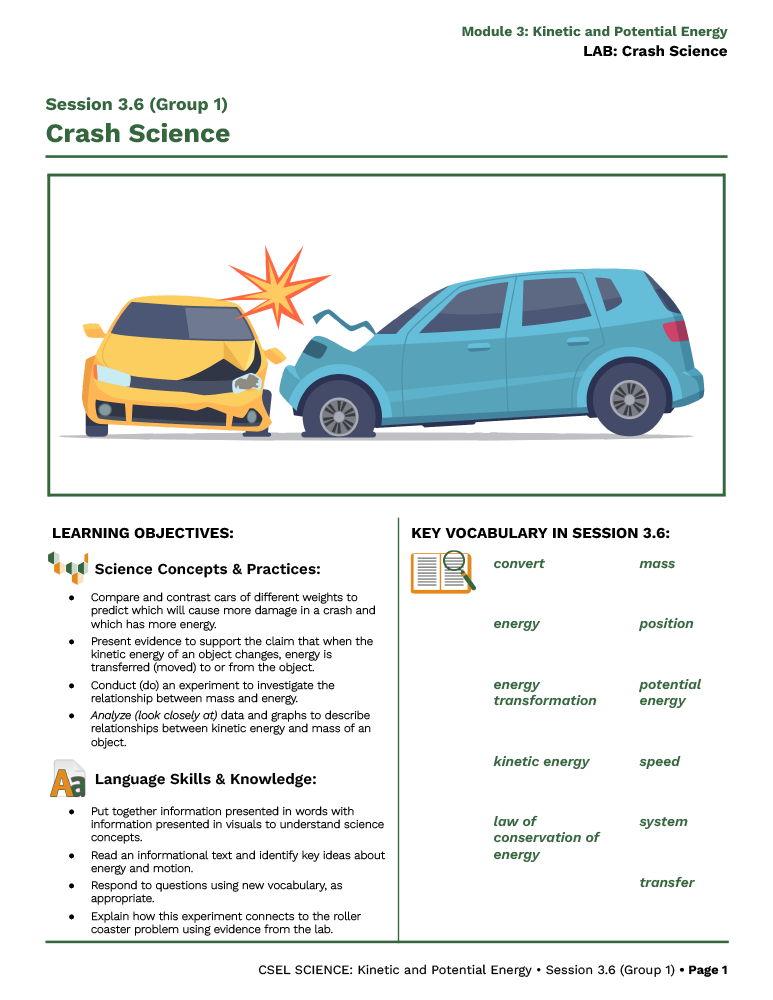
Session 3.6: Crash Science
In Session 3.6: Crash Science, students roll cars of different masses down a ramp and measure collision outcomes to explore how mass affects energy transfer.
Session 3.7: Solving the Roller Coaster Problem
Across these investigations, students analyze and interpret data by recording measurements, comparing trials, identifying patterns, and using evidence to support claims. In the culminating session, Session 3.7: Solving the Roller Coaster Problem, students use a digital roller coaster simulation to model the system, adjust variables such as mass and height, review energy bar graphs, and test solutions that enable the coaster to complete the loops. Students construct explanations and communicate their reasoning orally and in writing, using academic science vocabulary.
