CSEL SCIENCE
Leverage Students’ Home Languages.
An important approach is to leverage students’ home languages; in the classrooms, multilingual learners come from diverse language backgrounds. CSEL Science provides bilingual versions of module glossaries, side-by-side core content summaries in multiple languages, and flashcards for students to preview or review concepts in their home language. Currently, the glossaries and content summaries are available in 17 languages. Students are encouraged to discuss ideas with peers in their home language, when appropriate, to support conceptual understanding before expressing them in English.
Bilingual Glossary
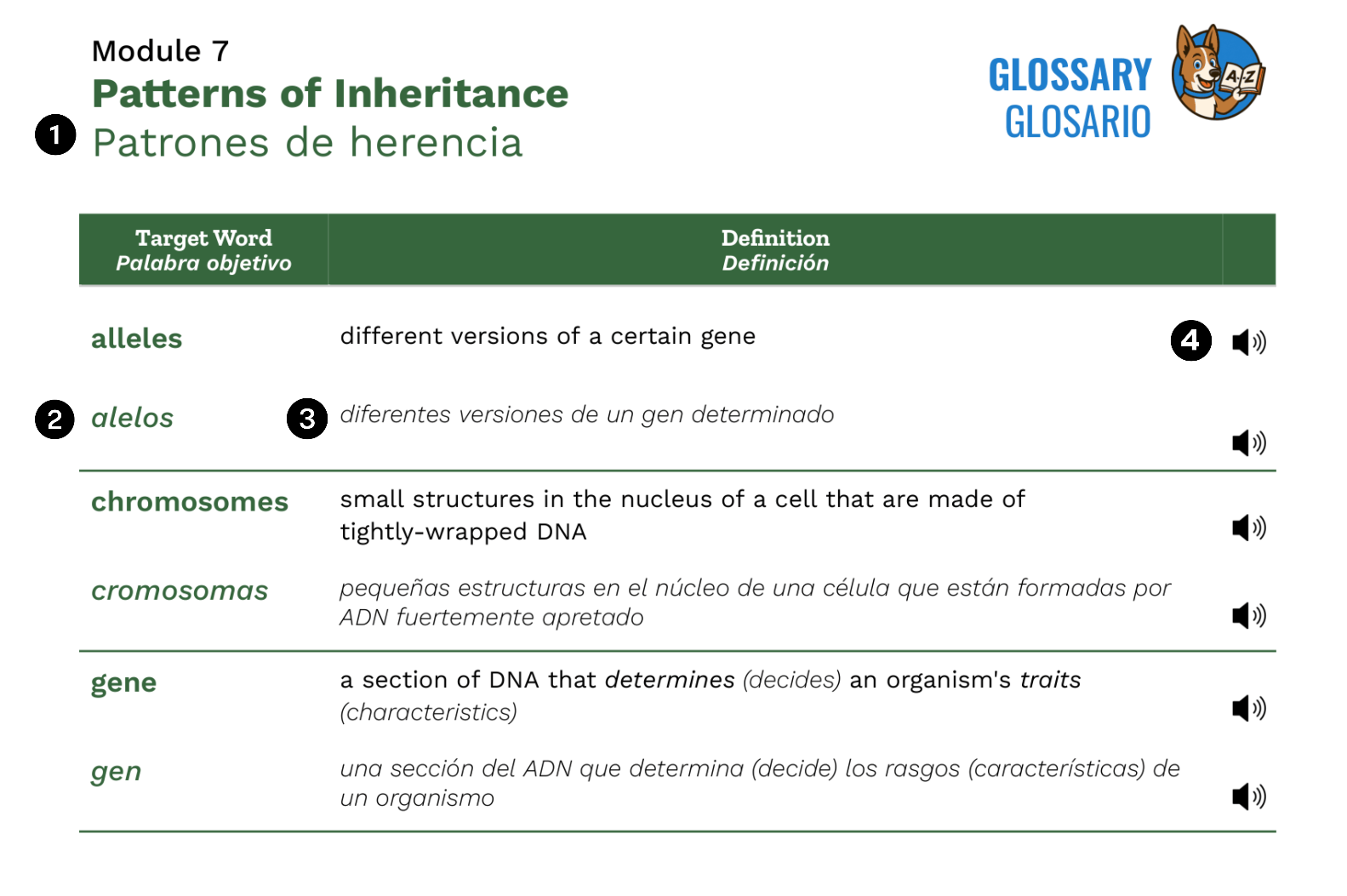
Description of key features highlighted:
1
Page titles and column headers are provided in the home language, enabling students to navigate the glossary and understand what each column displays.
2
The target word is translated into the home language, giving students a quick way to connect the English term to the word in their home language.
3
Brief, student-friendly definitions are translated into the home language.
4
Clicking the speaker icon lets students hear the word and its definition read aloud in English and, when available, in their home language. This supports pronunciation and allows students to access the glossary even if their reading is still developing in a first or second language.
The image below shows part of an English-Spanish bilingual glossary for Module 7:
Patterns of Inheritance. Numbered circles highlight key features of the glossary and are described below.
Side-by-Side Bilingual Content Summary
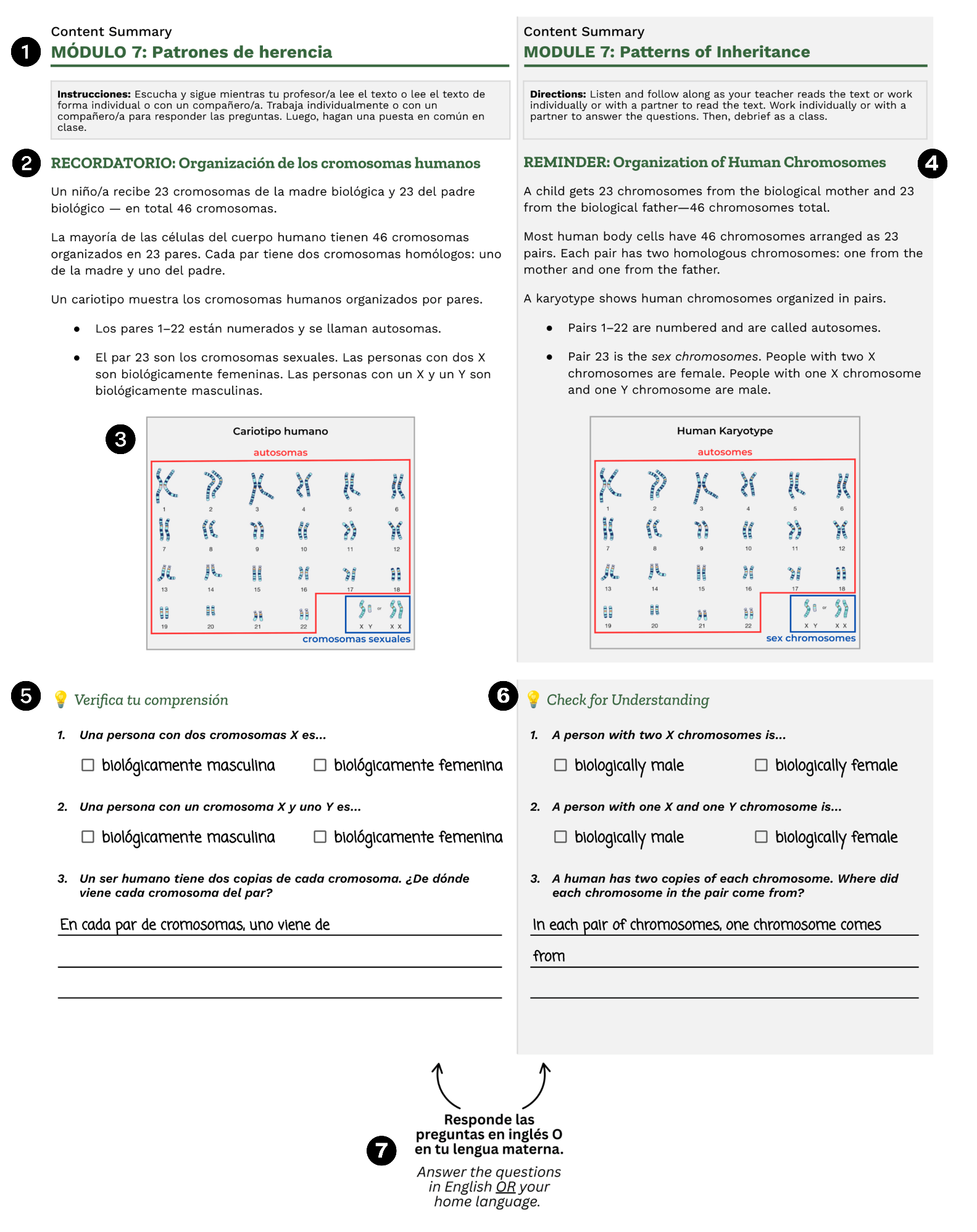
Description of key features highlighted:
1
All content on the left side of the page, including the page title, directions, captions, and footers, is provided in the students’ home language. This supports comprehension and enables students to navigate the document independently without relying on English-only cues.
2
The text is divided into smaller sections, making it easier for students to read and understand. Text features such as headers, subheaders, spacing, and bulleted lists help students identify key ideas, understand how information is organized, and navigate the content.
3
There are labeled illustrations in students’ home language and English that help all students understand the science concepts. The labels make clear connections between the illustrations and the accompanying text.
4
The same content is presented in English on the opposite side of the page. The mirrored structure enables students to move between their home language and English, supporting English language development while ensuring access to grade-level content in both languages.
5
Comprehension questions are included to help students understand both the text and visuals. “Check for Understanding” questions include multiple-choice and open-response formats with sentence starters.
6
All questions are translated into the home language. Answer options and/or sentence starters are also translated to support students in responding to the question.
7
Bilingual notes and instructions are included to help students navigate and use the document. These supports promote student independence, allowing teachers to focus on students' understanding rather than on navigating packets.
The images below and on the following page show the first two pages of the Spanish-English bilingual content summary for Module 7:
Patterns of Inheritance. In this activity, students listen to and or read the text, and work individually or with a partner to answer questions, followed by a classroom debrief. Key features are highlighted in the image below and on the next page using circled letters; those features are explained on the subsequent page.